


Founders Story Series
Agents produce every listing in America and own none of the data those listings create. So here is the question worth sitting with: what would actually change if the licensees who generate the data owned the system that holds it?
In almost every other industry, the people who create the valuable asset hold some claim on it. Songwriters keep publishing rights. Inventors hold patents. Even gig drivers are clawing toward ownership stakes in the platforms they power. Real estate is the conspicuous exception. A licensee does the work that produces a listing, the photos, the pricing, the disclosures, the comparable analysis, the relationship with the seller, and the instant that listing hits the MLS, the economic value of the data flows to everyone except the person who made it. Local boards charge dues to hold it. Technology vendors charge license fees to move it. Portals build market caps displaying it. Lenders and AI companies pay to scrape it. The agent who produced it gets none of that value, and depending on who is asking, may not even get clean access to it. This piece is an argument that the arrangement is backwards, and a walk through what the industry would look like if it were not.
I have spent seventeen years inside this. I have run an independent brokerage since 2007 and a platform that ranks agents on verified MLS performance data since 2009, built during the housing crisis so consumers facing short sales and foreclosures could tell a competent agent from a confident one. I was never handed the access an insider gets. I had to engineer my way to the data, market by market, because the organization that controls it was never interested in giving an outsider a fair and equal path to it. The conclusion I keep arriving at is that nearly every dysfunction in the listing system traces back to one root fact: the people who produce the data are the one party with no real claim on it. Change that single fact and most of the rest reorders itself.
I want to be specific about what "never interested" looks like, because I lived it. When I started ranking agents on their actual production, the National Association of Realtors did not respond with a data-sharing agreement. It responded with friction. I have been threatened over something as basic as using the word "realtor" to describe the very professionals my platform was built to surface, a word NAR guards as a trademark and wields to keep outsiders from describing the industry in plain English. And in conversations I will not soon forget, NAR executives told me directly that they did not want their membership ranked. Not that the methodology was flawed, not that the data was wrong. They did not want their members measured at all. Sit with that. The trade association representing more than a million agents views an objective, performance-based ranking of those agents as a threat to be discouraged rather than a service to be embraced. That posture is the entire reason this article exists, and it is the clearest possible evidence of who the current system actually serves. A system that suppresses measurement of its members is not serving the consumer trying to choose well, and it is not serving the high-performing agent whose record would speak for itself. It is serving the average one, by shielding the whole pool from comparison.
So when I argue the licensees should own the data, I am not theorizing from the sidelines. I am the person who spent seventeen years on the wrong side of that gate. The matrix below is the whole argument compressed into one view, and the sections after it reason through each piece.
The Question, Answered Five Ways
Who owns the data in each model, and what that ownership does to the licensee who feeds it
Scroll the table sideways to compare all five →
| Dimension | The ProposalUnifyMLS Cooperative | Status QuoRegional MLS System | Brokerage-OwnedCorporate Silo (Compass, Zillow) | Regional Gone NationalMRED + Compass Model | Vendor StackLegacy Platform Vendors |
|---|---|---|---|---|---|
| Who Owns It | The licenseesAgents and brokers who feed it, via a chartered cooperative. No outside shareholders. | 484 separate local boards and Realtor associations, each its own entity. | A single for-profit brokerage or an ad-funded public company answerable to shareholders. | One regional MLS, but financially steered by the brokerage subsidizing its agents and feeding its inventory. | The MLS licenses the software; the vendor owns the platform and the data pipes. |
| Governance | Cooperative, member-ledBroker-participants set policy. Charter bars sale to any vendor, brokerage, franchise, or PE firm. | Local board politics, NAR policy framework, volunteer committees. Slow and uneven. | A corporate board optimizing for its own P&L, not for the agents or the public. | MLS board nominally governs, but the funding partner holds outsized practical leverage. | Vendor product roadmaps set by the licensing company; MLS is a customer, not an owner. |
| Cost to Agent | $15–20 / month, all of itOne national subscription. No transaction fee, no royalty, no per-board stacking. | $1,000–2,000 / year for a multi-state agent, stacked across each local board and MLS. | "Free" to the agent, paid for by surrendering control of the listing data to the corporation. | Subsidized for the first 100,000 Compass agents, then presumably priced like any MLS. | Bundled into MLS dues; the agent pays the vendor markup without ever seeing the invoice. |
| Revenue Model | Two streams, paid back monthlyAgent subscriptions plus flat per-call API sales. 80–85% of the surplus returns to members as a monthly dividend on their quality data. | Member dues and assessments. Data-licensing revenue is captured by the vendor, not the members. | Listing data fuels the parent's commissions or ad business; agents see none of the data value. | Brokerage uses the MLS wrapper to distribute its private inventory; revenue serves the brokerage. | Six and seven-figure platform licenses plus distribution fees (Trestle, Spark) the MLS pays the vendor. |
| NAR Requirement | NoneNo NAR or local-board membership required to participate, post the 7.7 repeal. | Historically mandatory; now optional in a growing number of markets, but still required in many. | Varies; several large brokerages have already dropped the mandate for their own agents. | MRED decoupled from the NAR requirement in March 2026, which is the one thing it got right. | Set by the MLS the vendor serves, not by the vendor; usually inherited from local board rules. |
| Tech Foundation | RESO-native, built this decadeSingle national codebase, API-first, low-seven-figure build on modern cloud. | Whatever the local board licensed; often a decades-old platform patched for twenty years. | Genuinely modern in Compass's and Zillow's case, but built to serve the owner, not the industry. | Runs on the same legacy MLS platform underneath; national ambition on regional-era plumbing. | Matrix, Paragon, Rapattoni, connectMLS: mature, slow-moving, owned by firms optimizing for the exit. |
| Data Portability & Exit | Yours, and you can leaveRESO-standard outputs, no exclusivity, run any local MLS in parallel. Nothing held hostage. | Portable in principle via RESO, but practically tied to board membership in each market. | Listing locked inside the walled garden by design; leaving means losing the network. | Inventory commitments and subsidies create switching friction once an agent is in. | Data leaves only on the vendor's terms; integrations break when a state changes a field. |
| Capture Risk | Structurally blockedThe charter makes the asset unsellable to the buyers who would capture it. Nothing to acquire. | Low individually, but the fragmentation invites pickoff by consolidators one board at a time. | The capture has already happened; the data serves the corporation by definition. | High. A neutral wrapper around one brokerage's inventory was sued as a boycott within 22 days. | High. Cotality, formerly CoreLogic, is PE-owned by Stone Point and Insight, reportedly headed for an IPO; ICE bought Black Knight's Paragon for $11.9B. These are cash cows being primed for sale, not utilities. |
Legacy platform vendors named are the systems most U.S. MLSs run on: Cotality (formerly CoreLogic) / Matrix, FBS / Flexmls, ICE / Paragon, Rapattoni, and dynaConnections / connectMLS, with data distributed through Cotality's Trestle, FBS's Spark API, and MLS Grid. Stellar MLS, Bright, CRMLS and the like are MLS organizations that license this software, not vendors. The point of the column is not that the technology is bad. It is that the people who own it have no incentive to make listing data a public utility, because their business depends on the opposite.
01What Would Change If You Owned It
Start with the money, because that is the part you can test against your own checkbook without taking anything on faith. Picture a national listing system where the licensees are the owners and the pricing is set to serve them rather than to maximize a vendor's margin. The realistic number for a flat national subscription is $15 to $20 a month for unlimited listing input across every state and full access to the national inventory. Not per market, not per board. One subscription, $180 to $240 a year, total. Set that against what a multi-state agent pays now: most operating across three or four markets carry $1,000 to $2,000 a year in stacked local board dues, MLS fees, and association memberships just to reach fragmented coverage in each market separately. Under licensee ownership there is no transaction fee skimmed off closings, no franchise-style royalty, and no markup on tools you could buy yourself, because the owners have no reason to charge themselves any of those things.
The obvious objection is how a $20 subscription funds a national platform when local boards pay six and seven figures a year to license the systems they run on. The answer is the part of the question that actually matters, and it is the reason ownership changes everything rather than just shifting a fee around. The data you produce has enormous value to parties far beyond the agent community, and right now you capture none of it. Owning the system is what lets you capture it.
Follow that one step further and the subscription starts to look less like a cost and more like a wash. If the surplus from API sales is distributed back to members every month, an active listing agent is on both sides of the ledger: paying $15 to $20 in, and drawing a dividend out that scales with the quality data they contributed. For a genuinely productive listing agent, there is no reason that dividend cannot meet or exceed the subscription, which would put their net cost at or near zero. The agent who lists the most quality inventory could end up paying nothing to belong, or being paid to. I am not going to promise a specific number, because the dividend depends on API revenue that grows with national coverage and does not exist on day one. But the mechanism points in an unusual direction for this industry: the harder you work, the cheaper your access gets, until at some point the data you generate covers the cost of the platform that distributes it. No MLS in the country can say that today, because in every existing model the value of your data leaves the building and never comes back.
02Who Actually Pays for MLS Data Today, and Where That Money Goes
MLS data has an absurd value-to-cost ratio. Running one more listing through a database costs effectively nothing, but the data itself is worth a fortune downstream. Lenders pay seven figures a year to scrape the major distribution feeds. AVM providers pay comparable sums. Zillow's entire market capitalization rests on consumer-facing display of listing data that agents produce for free. AI companies are now paying real money for structured property datasets to train the next generation of consumer real estate products. Every dollar of that currently routes to the vendors who own the distribution layer and the portals that own the consumer eyeballs. None of it routes back to the licensees who created the data in the first place.
Licensee ownership flips that flow. Alongside a low agent subscription, an owned system sells API access to those same downstream consumers, lenders, AVM providers, portals, fintech, government appraisers, researchers, and AI training pipelines, at flat, published per-call rates, with no exclusive deals, ever. The no-exclusivity rule matters, because an exclusive deal is the first step toward exactly the capture problem this whole premise exists to prevent. Run the floor case: 100,000 paying agents at $20 a month is $24 million in annual subscription revenue before a single API call clears, and the API line carries eight-figure upside once national coverage is meaningful enough that a lender or AVM would rather pay one clean source than stitch together feeds from 484 separate MLSs. A managing entity runs the platform for a 15% to 20% fee, calibrated against what incumbent vendors actually charge once you strip out their bundled-software cross-sell. The remaining 80% to 85% of the surplus flows back to the brokers and agents who produced the listings, paid out monthly.
The data finally pays the people who make it, on a schedule they can actually feel.
What licensee ownership changes
The root fact
Agents create every listing and own none of the data. Lenders, portals, AVMs, and AI companies pay for that data. The money routes to everyone except the people who produced it.
The case for licensee ownership
03Ownership Only Means Something If the Mechanism Is Honest
"Licensee-owned" is easy to say and easy to fake, so the payout has to be specific or it is just marketing. Here is how it would actually work, and it is simpler than an equity story. There is no stock, no cap table, and no slow vest toward some distant exit. The cooperative takes in revenue every month from agent subscriptions and from API sales, pays its operating costs, and distributes the surplus back to the members who produced the data, as a recurring patronage dividend. Quality is the gate: your listing data has to be clean and real to qualify for the pool at all. Among the inputs that clear the gate, your slice of each month's distribution is proportional to the volume of qualifying data you contributed. You get paid this month for the data you put in this month. That is the whole mechanism.
Quality has to be the gate, because the gate is what protects the thing the API buyers are paying for. If the dividend paid out on raw listing inputs with no quality test, the rational move would be to flood the database with junk, expired listings, phantom inventory, garbage, to inflate your volume and skim a bigger share of the pool. So the data has to clear a quality bar before it counts toward your distribution at all: listings that never go live, obvious duplicates, stale or abandoned records, and data that fails validation simply do not qualify. Clean, real, complete listings do. The agent who contributes a high volume of quality data in a given month earns a correspondingly larger share of that month's surplus, and the agent who tries to game it with junk earns nothing, because the junk never clears the gate. The interests of the individual agent, the cooperative, and the data buyer all point the same direction, which is the entire point of running it as a member-owned cooperative instead of a vendor's product.
This is where "ownership" needs a precise definition, because it does not mean equity. It means cooperative membership: you are a member of the entity, you share in its surplus through the monthly dividend, and you hold governance rights over how it is run. What you do not hold is a tradeable share that an acquirer could buy. That is deliberate, and it is the protection that makes the whole thing durable. The cooperative would be chartered as a non-profit whose corporate documents prohibit sale to a vendor, a brokerage, a franchise, or a private equity firm. That prohibition answers the question every broker should be asking, which is what stops this from becoming the next thing that gets acquired and turned against me. The charter stops it, because there is no equity stake and no exit event for an acquirer to buy. The Broker Public Portal charter that now sits underneath Cribio is the closest existing model, and it works on the same logic: no advertising revenue, no profit distributions to outside owners, no outside ownership at all.
04The Questions a Skeptic Should Ask
A premise that dodges the hard questions is a daydream. Here are the four objections any broker who has been around long enough will raise, with straight answers.
Who Controls It?
The broker-participants, through cooperative governance, not a CEO and not a board of outside investors. There are no outside investors to answer to, because the charter prohibits outside ownership. A managing entity operates the platform under that charter; it does not own the data or set policy unilaterally.
Can I Leave, and Take Nothing Hostage?
Yes. No exclusivity. Your listings are yours, your data is portable by design under the RESO standard, and you can run any local MLS in parallel for as long as one exists in your market. The system has to earn retention by being better and cheaper, not by trapping your data.
What If It Fails?
You are out a subscription, not your business. Because there is no exclusivity and no transaction lock-in, participating is additive. You keep your existing memberships and tooling while it proves itself. The downside is a monthly fee; the upside is membership in national infrastructure that pays you a dividend on the data you already produce.
Why Would Buyers Pay for the API?
Because national coverage in one RESO-compliant feed is worth more to a lender or AVM than negotiating 484 separate MLS data licenses. They already pay seven figures to scrape fragmented feeds today. A single clean national source is a better product at a defensible price.
The one objection I cannot fully wave away is the chicken-and-egg problem, and I will not pretend otherwise. A listing system is worth joining once it has a critical mass of inventory, and it reaches critical mass once enough brokers join. That is a real cold-start problem. It is also exactly why the answer to the question cannot be one company quietly building a product and flipping a switch. Industry veteran Russ Cofano put the skeptic's version plainly, arguing it is a stretch for any single MLS to assemble listings from a few big players and thereby displace a local MLS that holds a critical mass of inventory. He is right about that. Which is the entire reason this has to be a genuine cooperative that many licensees seed at once, owned by them from day one, rather than one brokerage's inventory dressed up to look neutral. The next three sections show why that distinction decides everything, with eighteen months of live evidence.
05Why the Question Is Live Now
For roughly a century, the deal was that you joined the local board, paid the dues, and got the only keys to the for-sale inventory in your market. The mechanism enforcing that deal was NAR Policy Statement 7.7, the national policy that permitted local MLSs to require Realtor association membership as a condition of access. On November 17, 2025, at its NXT conference in Houston, NAR's Executive Committee repealed it, part of an 18-part handbook revision the association itself called the most extensive in twenty years. NAR no longer maintains any national rule tying MLS access to Realtor membership.
That repeal is why licensee ownership is now a buildable answer rather than a hypothetical that dies on a policy technicality. And the repeal did not happen because NAR reconsidered the value of membership. It happened because tying MLS access to association membership had become an antitrust liability NAR could no longer afford to defend after the Sitzer-Burnett verdict treated cooperative compensation as price-fixing. So NAR did the rational thing for an organization managing legal exposure: it pushed the access decision down to 484 individual local MLSs, removing itself as the single national chokepoint before someone removed it in court.
The field was already moving ahead of the policy. T3 Sixty estimates that 57% of MLS subscribers now belong to MLSs open to non-Realtors, a share projected to pass 66% by the end of 2026, and MLS subscriber counts already exceed Realtor membership by 25%, up from 13% in 2018. Six major brokerages, including Anywhere, RE/MAX, Keller Williams, Redfin, Realty ONE Group, and HomeSmart, have already dropped mandatory NAR membership. The board you used to have to join is becoming the board you can skip. The structural opening is real. The only question left is who owns whatever fills it, which returns us to the premise.
06Every Current Fight Is Happening Because Someone Else Owns the Data
Here is where the question stops being academic. Watch the listing wars of the last eighteen months and the pattern is identical every time: the fight exists precisely because a party other than the licensee owns the data, and they are all fighting over who gets to capture it. The licensee, the one with the fiduciary duty to the client, is the only party not at the table.
Start with the cleanest natural experiment. On April 24, 2026, Midwest Real Estate Data, the Chicago-area MLS that processes about 250,000 listings a year, announced it was opening its MLS and its Private Listing Network to any state-licensed agent in the country. A month earlier it had decoupled access from NAR membership, with CEO Rebecca Jensen explicitly citing expansion and reduced legal risk. On paper MRED did two things this premise calls for: it went national and it dropped the membership requirement. Then look at who owns the inventory flowing through it. Compass International Holdings agreed to syndicate its entire national inventory into MRED, including its Private Exclusive and Coming Soon off-market listings, and to subsidize the membership cost of the first 100,000 Compass agents who join. The largest brokerage in the world was underwriting a regional MLS's national expansion so it could route its own proprietary network through an MLS-shaped wrapper. That is not licensee ownership. That is one corporation renting an MLS charter to launder a walled garden into something that resembles open access.
The market's response was immediate. On May 12, 2026, eighteen days after the national rollout, Zillow filed a federal antitrust suit against both MRED and Compass, alleging the two conspired to choke off Zillow's listing access and force it to display listings on Compass's terms or lose entire MLS feeds, with parallel moves alleged at an LA-area MLS and at Nashville's Realtracs. The instant a system tied to a single brokerage's inventory tried to behave as national infrastructure, it triggered exactly the platform warfare that neutral, licensee-owned infrastructure exists to prevent. Twenty-two days from announcement to lawsuit. That is the evidence that corporate-owned listing infrastructure cannot stay neutral, because the ownership structure makes neutrality irrational.
A corporation built a national listing system and got sued in twenty-two days. A cooperative the corporations cannot buy is the only version of this that survives the fight.
The case for licensee ownership
07The Compass-Zillow War Was Never Fought for You
The MRED suit is one front of a larger war, and following it makes the ownership logic unmistakable. Compass became the largest residential brokerage in the world on January 9, 2026, when it closed its roughly $1.6 billion acquisition of Anywhere Real Estate, a deal valued near $4.2 billion with debt, producing a combined firm of about 340,000 agents at an enterprise value around $10 billion. That scale is the engine behind everything Compass now does with listing data, and it is already drawing scrutiny: New York Attorney General Letitia James's office has begun probing the combination and contacting rival brokerages for information.
Compass runs the three-phased marketing plan: launch a seller's home as a Private Exclusive, move it to Coming Soon, and only then release it to the public MLS, holding the listing and its data inside the Compass ecosystem as long as possible to capture both sides of the commission. Zillow's counter was its Listing Access Standards, barring any home publicly marketed elsewhere first from appearing on Zillow at all. The two spent most of a year in federal court. A judge declined to block the Zillow standards on February 6, 2026. Zillow reversed the ban on March 17, Compass dismissed its suit the next day, and the truce lasted about six weeks before the MRED partnership reopened the war on the MLS battlefield.
The part the trade coverage soft-pedals is that both combatants are fighting to privately capture infrastructure that should belong to no single company, and neither is fighting for the agent or the consumer. Compass wants the listing data inside its walled garden because it benefits Compass. Zillow wants all listing data on Zillow because it feeds the advertising business that is its actual product. Zillow's own Preview product, paying listing agents 10% of buy-side commission on leads tied to their listings, signals that the portals now court the listing-side relationships they never had to before. A for-profit brokerage and an ad-funded portal will each, rationally, route the data toward their own P&L, which is why neither can be its steward. The pocket-listing economics underneath all of it cost the seller on both sides, through worse exposure and reduced price discovery. The licensee is the only party in the entire system whose interests already align with open access, because the licensee has a fiduciary duty to get the seller the best result. That alignment is the answer to the question. The party that should own the data is the party already obligated to use it correctly.
08What the Answer Looks Like, and What It Needs
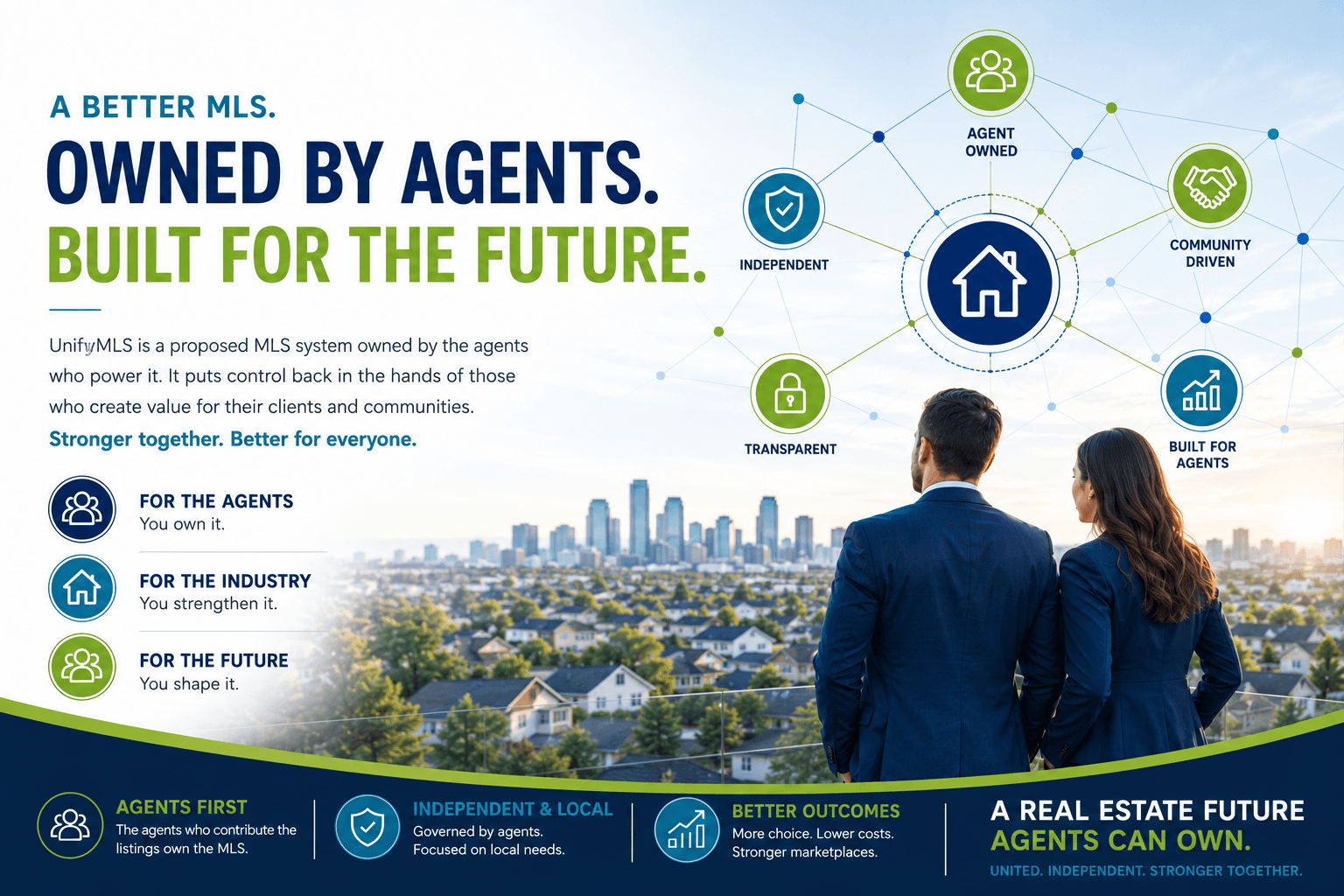
Everything above is the question and the reasoning. Here is the answer with a name on it. I have been calling it UnifyMLS since 2023, and the design is the one this whole piece has been describing: a national listing utility owned by the licensees who feed it, priced at $15 to $20 a month with no NAR requirement, two revenue streams at published rates, and a monthly patronage dividend that returns the surplus to members in proportion to the quality data they contribute, all under a charter that makes it unsellable to any vendor, brokerage, franchise, or PE firm. It is a working blueprint, not a launched product, and I will keep saying that plainly because the entire argument depends on the specifics being honest. I have the structural design, the participation agreement, the data-quality standard, and the vendor experience behind it. What I do not yet have is the engineering team, the founding broker commitments, and the capital for the first eighteen months.
The opening is better in 2026 than it has ever been, and it is temporary. NAR modified its Clear Cooperation Policy on March 25, 2025 with the Multiple Listing Options for Sellers framework, creating a delayed-marketing exemption local MLSs implement at their discretion. The 7.7 repeal removed the national chokepoint. RESO's data dictionary has matured to where a compliant national platform interoperates with existing local feeds without bespoke integration, and cloud economics put the full build in the low seven figures, not the nine figures the American Real Estate Association is trying to raise for its own national service. The window closes the longer the private experiments run unchallenged. Once Compass, eXp, and the franchise-aligned networks each own their own listing rails, the bad equilibrium locks in: worse exposure for sellers, less data for consumers, more rent extraction by whoever holds the largest agent roll. The brokerage consolidation cycle that just absorbed the franchise brand layer when Real bought RE/MAX at roughly 7x EBITDA will absorb the listing layer the same way, unless licensees build the one alternative the consolidators are chartered out of acquiring. The industry has until roughly 2028.
So here is the ask, and it is specific. I am looking for founding broker-participants who currently pay six figures to participate in MLSs they do not own and who will commit listings to a licensee-owned cooperative on launch, as founding members with a permanent seat in how it is governed and a dividend from the first month the data starts earning. I am looking for engineers who have shipped enterprise data platforms and understand RESO modeling and API-gateway architecture. And I am looking for operators who have run two-sided marketplaces in regulated industries and know the difference between a venture land grab and a cooperative chartered to govern itself for fifty years. I made a version of this attempt in 2023 by cold-calling the three MLS vendors, and watched all three route my request up to NAR before they would quote me, which is the entire reason the 2026 version starts from owned infrastructure instead of rented permission. I still own unifymls.com, parked since the last vendor declined to bid. I am ready to point it at something real the moment a founding team exists. You can reach me at kevin@effectiveagents.com.
The thesis in one sentence
The licensees who produce the data are the only party whose interests already align with open access. The question is not whether they should own the MLS. It is why they still do not.
UnifyMLS cooperative model
Sources
- T3 Sixty via PR Newswire, "Record Gap Emerges Between MLS Subscribers and Realtor Members," June 4, 2025. prnewswire.com
- T3 Sixty Real Estate Almanac via PR Newswire, "MLS, Local Association Counts Fall as Consolidation Reshapes Industry," March 4, 2026. prnewswire.com
- Inman, "NAR by the numbers: dues flat, members sticky, cost cuts ahead," November 18, 2025. inman.com
- GlobeNewswire, "MRED Expands Its Private Listing Network to All Brokers Nationwide," April 24, 2026. globenewswire.com
- Inman, "Zillow Sues Compass And Chicago's MLS Over Private Listing Battle," May 12, 2026. inman.com
- The Real Deal, "Compass-Anywhere merger has closed: here's what to know," January 9, 2026. therealdeal.com
- Real Estate News, "CoreLogic rebrands as Cotality," March 24, 2026. realestatenews.com
- Inman, "With Recent Expansions, MLS Consolidation Poised to Speed Up," May 5, 2026. inman.com
Disclaimer: This article is an industry analysis and opinion piece by the founder of EffectiveAgents. UnifyMLS is described as a proposed structure that is not yet operational; figures for pricing, revenue, and fees are design targets, not results. Deal terms, regulatory dates, and industry figures are sourced from the public press releases and trade publications cited above and from NAR's published policy actions. EffectiveAgents is an independent agent matching service that ranks real estate agents using verified MLS performance data. Nothing in this article constitutes financial, investment, or legal advice.