


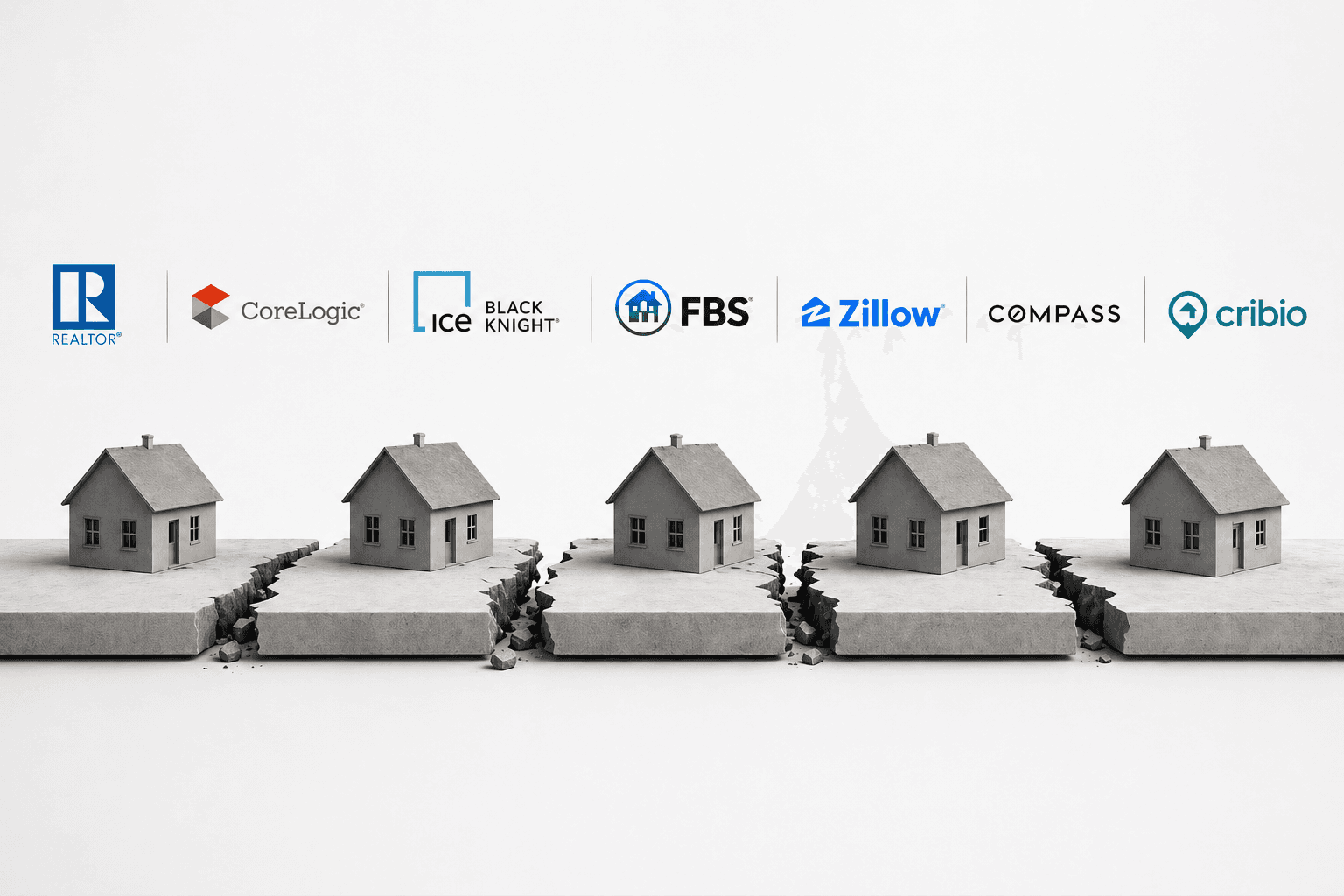
In November 2023, three weeks after the Sitzer-Burnett verdict cracked open the most defensible window for a national MLS in twenty years, I called every major MLS infrastructure provider in the country and asked them to bid the job. None of them wanted my money. Every one of them saw me as a threat. That is the entire reason America still does not have a national MLS, and it is the reason we are not going to have one until somebody builds it without asking the gatekeepers for permission.
On October 31, 2023, the jury in Sitzer-Burnett returned a $1.785 billion verdict against the National Association of Realtors, Keller Williams, and HomeServices of America after two and a half hours of deliberation, automatically trebled to $5.356 billion under federal antitrust law. The verdict identified NAR's cooperative compensation rule as a price-fixing conspiracy and made the next nine months the only window in a generation when an alternative listing infrastructure could be built without fighting the entire incumbent apparatus head-on. I read the verdict that Tuesday afternoon, registered the unifymls.com domain that week, and started cold-calling vendors. The thesis was specific. Build a separate national listing ecosystem for properties that did not offer buyer compensation, route the data feed flat to anyone who could pay the per-call cost, and let agents participate without dragging their NAR-affiliated local memberships behind them. The original 2023 pitch deck politely assumed agents would keep their existing local memberships in parallel; that was the diplomatic version of the model the vendors needed to hear. The honest version, which the post-Sitzer reality has only sharpened, is that NAR's competitive advantage was the cooperative compensation rule, that rule is now illegal, and the bundled local-board membership that used to gate MLS access is now a value proposition without a product. Lockbox vendors sell to non-NAR brokerages already. Continuing education has third-party providers in every state. The Realtor trademark is worth what consumers think it is worth, which is approximately nothing. UnifyMLS members are not required to maintain local board memberships, and most of them, once the structure exists, will not.
01The Window
The Sitzer settlement, which NAR signed in March 2024 and which took effect across every MLS in the country on August 17, 2024, did two things that mattered structurally. It removed offers of cooperative compensation from MLS displays, and it required written buyer agency agreements before any agent could show a buyer a home. Those two changes broke the assumption every existing MLS had been built around since 1996, when NAR first adopted the blanket-unilateral-offer-of-compensation rule. By the back half of 2023, anyone running a brokerage knew the rule was about to be ruled illegal, and any MLS still requiring cooperative compensation as a condition of listing was about to be holding the bag.
The cleanest move for an entrepreneur looking at that timeline was to position outside the existing system entirely. The strongest objection to a national MLS comes from Saul Klein, the longtime SDMLS chief who told HousingWire in March 2026 that he thinks the idea is "a dumb idea," that most people advocating for one do not understand what MLSs actually do, and that the right answer is a federation of local MLSs providing national access rather than a single national entity. The deeper objection underneath all three of those points is the industry axiom that real estate is local and a national entity cannot be expert in fifty states' licensing, disclosure, and compliance regimes. The objection has always been weaker than it sounds, because the rule layer it gestures at was never the local MLS's responsibility in the first place. Licensing enforcement is a state function and always has been. Florida has DBPR, Texas has TREC, California has DRE, each with subpoena power, fining authority, and statutory backing the local MLS does not have and never had. What the local boards have always actually been was a paid layer of private rule-enforcement layered on top of the actual law, charging dues for the privilege of obeying rules NAR invented. The "local expertise" defense was the cover story. AI has now made even the cover story untenable. A fine-tuned model trained on every state's licensing statutes, every form set, every local disclosure regime, and every county-level recording quirk fields the same query at near-zero marginal cost. The 484 fragmented regional databases are not preserving local expertise that would otherwise be lost. They are preserving a cost structure whose original justification was thin in 1996 and is fully obsolete in 2026. The licensing layer is not what the local MLSs are protecting. They are protecting the data layer, and the data layer wants to consolidate the way every other piece of digital infrastructure has consolidated since 1995. UnifyMLS was the working name. The model was a $15 to $20 monthly subscription for agents in exchange for unlimited national listing input and member access, RESO-compliant data outputs to any consumer willing to pay a per-call rate, and a governance structure that gave broker-participants ownership of the cooperative rather than payment-in-perpetuity to a vendor.
The plan needed two things to ship: a listing input platform (the agent-facing software where listings get entered) and a data distribution layer (the IDX/VOW/RETS feeds that move data to consumers). Both were vendor-buy decisions in 2023. The participation agreement and data quality standard were drafting work I handled myself. I also drafted a more elaborate rules and regs document framed in the language of a traditional MLS, because that was the diplomatic version of the pitch the vendors needed to hear in late 2023 to take a meeting. The fuller version of the argument, the one I am making in this article, was not yet writable in a vendor sales call. By the second week of November 2023 I had calls scheduled with the three companies that own the U.S. MLS technology stack between them.
02The Calls
The first call was to FBS, the Fargo-based company behind Flexmls, which serves roughly 230 MLSs and around 600,000 agents. Matty Epstein, their director of MLS sales, took the meeting. I walked him through the model. Listings without buyer compensation. Separate ecosystem from existing local MLSs. National coverage. Subscribers pay UnifyMLS, UnifyMLS pays FBS for the listing input platform. One week later his colleague Katie Kapel, business development manager at FBS, sent the brush-off in writing on December 19, 2023: their team would be most efficient waiting on a proposal until I had subscribers. That is a vendor with a paying buyer in front of them telling that buyer to come back when they had already solved the problem they were calling FBS to solve.
The second call was to CoreLogic, which runs Matrix (the desktop platform powering close to half of U.S. MLSs), MLS Touch (the consumer-facing mobile app), OneHome (the agent toolbox), Clareity (single sign-on), and Trestle (the data distribution layer that pipes MLS data to portals, AVMs, lenders, and downstream tech vendors). A principal of business development at CoreLogic laid out the full stack on a call November 8, 2023. Then radio silence. On November 14 I followed up, and a CoreLogic colleague replied that evening. I will get to the specific reply in a moment, because it is the single most revealing sentence in the entire seven months I spent trying to spin the thing up.
The third call went to Black Knight, which had been acquired by Intercontinental Exchange just seven weeks earlier in an $11.9 billion transaction that closed September 5, 2023, sweeping their Paragon MLS platform into ICE Mortgage Technology. Kathi King, director of real estate industry relations under the new ICE flag, and Terry Tanner from her team, took the meeting on December 13, 2023. They were the most polite of the three. They scheduled a follow-up call with their VP of implementation and data services for the following Friday. They asked specifically about Paragon Connect as a listing input platform. The pattern from FBS repeated. Calls, follow-ups, polite emails, then the proposal that never arrived.
| Vendor | First Call | Stack Discussed | Outcome |
|---|---|---|---|
| FBS | Dec 12, 2023 | Flex listing input platform | Declined to bid |
| CoreLogic | Nov 8, 2023 | Full stack: input, distribution, SSO | Months later, after NAR-mediated review |
| ICE Mortgage Tech | Dec 13, 2023 | Paragon Connect listing input | Stalled. No proposal. |
None of them wanted my money. Every one of them saw me as a threat.
The three calls that revealed the structure
03The Email That Gave the Game Away
The reply came in the November 14 follow-up. A CoreLogic exec had met with NAR the prior week and was, in the email's exact phrasing, "locked down at NAR" with an internal call that week to another internal decision-maker. They would be back in touch as soon as they had clarity.
Read that twice. CoreLogic, the vendor I was trying to pay, was checking with the National Association of Realtors before deciding whether to take my money. The meeting they described was not about technical compatibility or compliance guidance. It was an internal CoreLogic-NAR discussion to determine whether CoreLogic was allowed to sell their software stack to a national listing service the trade association had not blessed. What that describes is a cartel structure where the trade association functions as the gatekeeper deciding which buyers a vendor is permitted to serve, regardless of whether anybody at NAR or CoreLogic would describe the arrangement that way out loud.
The CoreLogic-NAR relationship is not arms-length. CoreLogic was the data partner that powered Realtors Property Resource, the NAR-owned property database every NAR member receives access to as part of their dues. CoreLogic's Trestle distributes MLS data to NAR's consumer-facing properties, and CoreLogic's Matrix is the listing platform powering MLSs whose existence depends on NAR-affiliated Realtor associations being the buyer of record. A vendor whose largest revenue category sits inside a customer base that NAR controls is a vendor whose product manager will, when a national MLS founder calls, walk the request up the chain to NAR before responding. The system is working exactly as designed, even though no one wrote the design down anywhere.
To CoreLogic's credit, they did eventually come back with a workable proposal after several more months of internal coordination and additional NAR-mediated reviews. They were the only one of the three vendors who got there, and that deserves recognition. The structural delay alone made the post-Sitzer launch window unworkable, regardless of whether the eventual answer was yes. By the time CoreLogic was clear to do the deal, the moment that opened it had already passed, and the bigger thesis question was already different: not whether to rent the stack from a vendor, but whether to build it on owned infrastructure from the ground up.
04Why None Could Move Fast Enough
The vendors were rational actors operating inside a structure that punishes them for doing the deal. FBS, CoreLogic, and ICE Mortgage Technology each sell into a customer base of roughly 500 NAR-affiliated MLSs, and each of those MLSs operates under NAR's Multiple Listing Policy framework. The policy framework is the buyer leverage. NAR cannot directly tell CoreLogic which customers to serve, but NAR can revise the policy framework in ways that make Matrix's certifications, integrations, and standard-conformance status materially harder to maintain. Selling to a non-NAR-affiliated national MLS, particularly one that publicly framed itself as routing around the cooperative compensation rule that was the entire architecture NAR was defending in court, was not a deal any of these vendors could close without the trade association's explicit blessing.
The trade association's explicit blessing was not going to come on any timeline that worked for the post-Sitzer window. NAR had spent the back half of 2023 fighting Sitzer-Burnett and bracing for the wave of copycat litigation that Michael Ketchmark filed within hours of the verdict. The last thing NAR wanted to be processing in real time was a parallel listing infrastructure that publicly framed itself as a Sitzer-compliant alternative. The vendors stalled, the trade association did not have to lift a finger to enforce anything, and the months of internal review that any deal eventually required became the gating constraint on their own.
The deeper problem is that none of these vendors had a financial reason to move quickly on a deal that would eventually generate pricing transparency on their existing book of business. A national MLS, even an additive one, eventually shows what an MLS technology contract should cost. Local MLSs pay six and seven-figure annual licenses for software whose marginal cost of running another listing through is effectively zero. A national platform with a flat per-listing input fee makes that pricing visible to every local board CEO who currently signs the existing contracts. Every vendor I called had a financial reason to slow-walk the deal, and the fact that they could blame NAR for the delay was a feature, not a bug.
05What Got Built in the Two Years Since
The honest answer is that the industry has spent the two years since Sitzer-Burnett building everything except the thing that needs to exist. The MLS count has fallen from 514 at the end of 2024 to 484 at the end of 2025, the steepest single-year decline since T3 Sixty began tracking the data, and a 43% drop from the 2015 peak of roughly 850. The top 20 MLSs now generate 49% of total sector revenue. The consolidation is happening, but it is happening through regional rollups rather than national infrastructure, which means the underlying problem (every agent crossing a state line still needs to join a new MLS) is exactly as bad as it was when I picked up the phone in 2023.
The American Real Estate Association, launched January 2024 by Mauricio Umansky and Jason Haber, has the most coherent vision on paper: a unified national listing service offered through a $20-introductory-tier trade association that would, in Umansky's words, let agents pay one fee for access to the entire country. The execution has been slower than the vision. AREA is at roughly 5,000 members as of early 2025. The National Listing Service it points to (theNLS.com, evolved from Umansky's original ThePLS.com) does not yet have comprehensive national coverage and remains in active litigation with NAR over the Clear Cooperation Policy. Umansky and Haber said publicly they were targeting a $50 to $100 million raise to capitalize the build. As of the most recent reporting, that capital has not closed.
The Broker Public Portal, founded in 2014 and rebranded as Cribio in September 2025, is the closest thing to a working industry-owned alternative. Cribio currently covers MRED, Canopy, MIBOR, Doorify, RMLS Alliance, and OneKey MLS, totaling roughly 125,000 agents on a per-agent fee structure of $0.50 per month. Its charter prohibits advertising revenue, profit distributions, and outside ownership, which is the right governance design. But Cribio is a consumer search portal sitting on top of participating MLS data, not a unified national listing input platform. It does not solve the problem of an agent licensed in three states having to pay membership in three local boards to put a listing into a database in any of them.
The Compass-Zillow proxy war is a separate development that matters here. Compass ran 19,393 listings through its Private Exclusives network in Q1 2025 alone. Zillow announced its Listing Access Standards on April 10, 2025, started enforcement June 30, and by November 14, 2025 had banned 48 listings from its platform, 90% of them Compass listings. A federal judge denied Compass's request for a preliminary injunction against Zillow on February 6, 2026. The Compass strategy is to build a private network owned by one brokerage. The Zillow position is that all listings must go to a public MLS within one business day. Both positions describe what a national MLS should not be. The pocket-listing economics end up costing the seller in both directions, and the only structural fix is a neutral utility that no single brokerage owns and no single portal can leverage.
NAR itself made the most consequential move quietly. On November 14, 2025, the association announced it was shifting rule-making authority on disciplinary actions and MLS access from the national level down to local MLSs and associations. That decision, more than any of the other 2025 developments, is the structural opening. The local MLSs have always been the ones with the practical leverage to opt into a parallel system. The national-association brake just got released.
06What an Actual National MLS Should Look Like
The local-MLS structure is unbundled into the four things it actually does, and three of those four are reassigned to the entities that should have been doing them all along. Listing data exchange consolidates into a single national cooperative. Display and distribution standards are RESO's job already; the cooperative adopts the standard and the API enforces it. Conduct enforcement reverts to the state regulators who have actual statutory authority for it. Trade association activity (training, advocacy, code of ethics, networking, political action) survives in some form, but it is going to shrink substantially even at that layer. Local boards face real competition now from AREA on the trade-association side, from independent broker associations and vertical-specific groups on the networking side, and from third-party CE providers on the training side. Once the data layer is no longer bundled with the membership, the membership has to compete on its merits, and most local boards are going to find that the merits do not justify the dues. The four design choices below are interconnected and the system breaks if any single one is removed. A non-cooperative governance, a vendor-controlled stack, a non-flat distribution pricing, or a managing entity that takes more than 20% all destabilize the model in different ways, and the existing alternatives (Cribio, AREA's NLS, Compass Private Exclusives, the legacy NAR-affiliated MLSs) each fail one or more of these tests.
No Private Regulator
The cooperative has no disciplinary committee, no fines, no suspension authority, and no internal "ethics" enforcement layered on top of state licensing law. Conduct violations route to the state real estate commission that has actual statutory authority. The cooperative's only enforcement tool is participation: a broker who repeatedly contributes false or stale data loses API access, just like any other commercial data partner.
Agent-Owned
Ownership stakes vest pro-rata against closed-and-funded transaction volume, not raw listing inputs. Listings that fail to sell, listings with high cancellation ratios, and listings with significant list-to-sale variance all score down. API buyers will not pay for junk data, so an agent stuffing the database with low-quality listings would directly destroy the revenue they are trying to capture.
Two-Stream Revenue, Published Rates
Agents pay a $15 to $20 monthly subscription for unlimited national input and member access. API consumers (lenders, AVM providers, portals, fintech, AI training pipelines, government agencies) pay flat per-call rates. RESO-compliant outputs by default. No exclusive distribution deals, ever.
Public Utility
Operates for the benefit of every constituency that depends on accurate housing data: residents shopping for homes, agents listing them, lenders pricing them, county appraisers valuing them for taxation, AVM and fintech providers building downstream tools, academic researchers studying housing markets, and AI companies training the next generation of consumer real estate products. Chartered as a non-profit cooperative whose corporate documents prohibit sale to a vendor, brokerage, franchise, or private equity firm. The Broker Public Portal charter that now sits underneath Cribio is the closest existing model.
The mental model is a local ISP, not a private database. An ISP does not decide who is allowed to use the internet. It sells access at a published rate to anyone who will pay, and the network benefits everyone who plugs in. The MLS should work the same way. Open data benefits residents through better liquidity and transparent pricing. It benefits local governments, where county property appraisers and tax assessors currently rely on stale or expensive third-party feeds to value the homes they are statutorily required to assess. It benefits lenders through faster underwriting and fewer mispriced loans. It benefits academic researchers studying housing markets, who currently cannot run serious empirical work without negotiating six-figure data licenses. And it benefits the AI companies whose next generation of consumer products will depend on clean, structured, openly-licensed property data. The current MLS structure walls all of that value off behind NAR membership, vendor licensing, and portal exclusivity deals. The cooperative model treats it as the public infrastructure it should always have been. Compass Private Exclusives and Zillow Listing Access Standards are both, in different ways, private capture of what should be a public utility. Compass wants the data inside their walled garden because it benefits Compass agents. Zillow wants all the data on Zillow because it benefits Zillow's ad business. Neither is operating in the public interest. The cooperative explicitly is.
The economics work because MLS data has an absurdly high consumer value relative to its marginal production cost. Lenders pay seven figures per year to scrape Trestle. AVM providers pay similar. Zillow's market capitalization is built on consumer-facing display of data the agents produce for free. AI companies are paying for property datasets to train their models. The current structure routes essentially all of that value to the vendors that own the distribution layer and the portals that own the consumer eyeballs. A national utility that owns the input layer captures the data-licensing economics for the agents who created the data.
The 15% to 20% management fee is calibrated against actual industry economics. CoreLogic's Trestle, FBS's Spark API, and ICE's Paragon RESO endpoints each operate at margins well above that range when you back out their bundled-software cross-sell. The cooperative runs two identifiable revenue streams. At 100,000 paying agents at $20 per month, the agent subscription line alone generates $24M ARR before any other revenue. API revenue from lenders, AVMs, portals, fintech, and AI training pipelines is the second and more variable line, with realistic upside in the eight figures once national coverage is meaningful. Running a single platform on a single codebase, with no franchise overhead and no paid sales motion to local boards, makes the 15% to 20% take comfortably profitable for the managing entity while leaving 80% to 85% of top-line for distribution to the brokers who actually do the work of producing the listings, weighted pro-rata against closed-and-funded transaction volume.
The agents producing the data should own the asset the data creates. Right now they don't. That is the entire problem and it is fixable.
The thesis in one sentence
07The Window Has Not Closed. It Moved.
The 2023 window was specific to the Sitzer-Burnett aftermath. The 2026 window is structurally different and, in important ways, more durable. NAR's Clear Cooperation Policy was modified March 25, 2025 with the Multiple Listing Options for Sellers framework, which created a delayed-marketing exemption that local MLSs implement at their own discretion. The local-MLS rule-making authority that NAR ceded in November 2025 means there is no longer a single point of failure where the national association can block a parallel system. Two hundred-plus MLS CEOs each get to make their own call on whether to participate.
The technical preconditions are also better. The Real Estate Standards Organization's data dictionary has matured to the point where a RESO-compliant national platform can interoperate with every local MLS's existing data feed without bespoke integration work. A founder building UnifyMLS in 2026 has a six-to-twelve-month engineering timeline, not the multi-year build that would have been required in 2019. Cloud infrastructure costs are a fraction of what they were when CoreLogic and Black Knight architected their stacks. The full input-platform-plus-distribution-layer build, with proper engineering, runs in the low seven figures, not the nine figures that AREA is trying to raise.
The Compass-Zillow lawsuit, the AREA-NAR lawsuit, the Gibson class action that is still working its way through Western Missouri, and the ongoing DOJ scrutiny of NAR's MLS policies have collectively created the most permissive antitrust environment for parallel listing infrastructure in fifty years. The Zillow Preview rollout earlier this year, where listing agents earn 10% of buy-side commissions on Zillow Premier Agent leads tied to their own listings, is one specific signal that the portals are now competing for listing-side relationships in ways they never had to before. The leverage that NAR-affiliated MLSs have historically held over the listing data is dispersing in real time. Whoever shows up with a credible alternative platform in the next twenty-four months has the most defensible window to build a public utility that the industry has seen since the original MLS cooperative was incorporated in the 1880s.
The honest read is that this window also closes. The longer the AREA NLS, Cribio, and various private-network experiments operate without consolidation, the more likely it is that the listing layer fragments into a permanent set of brokerage-owned silos. Once Compass, eXp, Howard Hanna, and the various franchise-aligned MLSs each own their own listing network, the bad equilibrium is locked in: worse outcomes for sellers, less data for consumers, and more rent extraction by the brokerages with the largest agent rolls. The industry has between now and roughly 2028 to consolidate around a neutral utility before the silo equilibrium becomes the default.
08Build It With Me
I have been running an independent brokerage since 2007 and a consumer-facing platform that ranks agents on verified MLS performance data since 2009. I have done the participation agreement, the data quality standard, the local-board outreach, the vendor calls, and the structural design work. What I do not have is the engineering team to build the input platform and the distribution layer in parallel, the capital to run the first eighteen months of operations before subscription and API revenue start covering payroll, and the founding broker-participant commitments that turn the participation agreement from a draft into a contract.
I am looking specifically for three categories of co-conspirator. Tech leaders who have shipped enterprise data platforms at scale (RESO data modeling, real-time syndication, API gateway architecture, the boring infrastructure work that the consumer portals get all the credit for) and who recognize the listing-layer economics for what they are. Brokers of record who currently pay six figures a year to participate in MLSs they do not own and who are willing to commit listings to a parallel platform on launch. And operators who have run two-sided marketplaces, particularly in regulated industries, and who understand the difference between a venture-backed land grab and a chartered cooperative that has to govern itself for fifty years without selling out.
The pricing commitment is concrete. Agents pay $15 to $20 per month for unlimited national input and member access. That is $240 a year against the $1,000 to $2,000 most multi-state agents currently pay to maintain memberships in three or four local boards just to access fragmented coverage. API consumers pay published per-call rates with no exclusive deals. Brokers and agents who participate from the founding period vest cooperative ownership pro-rata against closed-and-funded transaction volume, which means the agents producing the highest-quality data in year one capture the corresponding share of the data-licensing economics in years three, five, and ten.
The funding model is straightforward. Founding contributors take vested equity in the managing entity. The managing entity raises a modest convertible round to fund the build, repays it from the 15% to 20% top-line take, and runs the platform under the cooperative's charter for the long term. The endpoint is a working national utility governed by the agents and brokers who depend on it, operating on a fifty-year horizon rather than a five-year venture timeline, with no IPO and no strategic sale at the end of it.
If the broader argument here lands for you, and if the prior piece on the franchise consolidation cycle (Real acquiring REMAX at 7x EBITDA) lands as well, you already understand why the listing layer is the next domino. The brokerages that win the next decade are the ones that own their stack. The MLS data is the most strategically important piece of that stack and it is currently rented from vendors whose interests are not aligned with the agents who produce it. The brokerage consolidation cycle is going to absorb the listing layer the same way it absorbed the franchise brand layer, unless somebody builds an alternative the consolidators cannot acquire.
You can find me at broker@effectiveagents.com. I still own unifymls.com; it has been parked on a holding page since the last vendor declined to bid in early 2024, and I am ready to point it at something real as soon as a founding team is in place. The structural draft from December 2023 is still on my hard drive. The diplomatic version I sent the vendors needs replacing now that the post-Sitzer regulatory environment lets us argue the actual position out loud, but the underlying design held up. The vendors did not say yes in 2023 on any timeline that mattered, and even when CoreLogic eventually came around the structural delay had already cost us the launch window. The premise of UnifyMLS in 2026 is that we own the stack and bring vendors in only as optional implementation partners, not as gatekeepers whose internal NAR-clearance process determines our launch schedule.
Sources
- Real Estate News, "Jury sides with home sellers in commissions trial," October 31, 2023. realestatenews.com/2023/10/31/jury-sides-with-home-sellers-in-commissions-trial
- HousingWire, "ICE completes $11.9B acquisition of Black Knight," September 5, 2023. housingwire.com/articles/ice-completes-11-7b-acquisition-of-black-knight
- T3 Sixty Real Estate Almanac via PR Newswire, "MLS, Local Association Counts Fall as Consolidation Reshapes Industry," March 4, 2026. prnewswire.com/news-releases/mls-local-association-counts-fall-as-consolidation-reshapes-industry
- National Association of Realtors, "NAR Introduces New MLS Policy to Expand Choice for Consumers," March 25, 2025. nar.realtor/newsroom/nar-introduces-new-mls-policy-to-expand-choice-for-consumers
- HousingWire, "Mauricio Umansky and Jason Haber launch new real estate trade group," January 24, 2024. housingwire.com/articles/mauricio-umansky-and-jason-haber-launch-new-real-estate-trade-group
- HousingWire, "OneKey MLS partners with Broker Public Portal for home search," February 18, 2026. housingwire.com/articles/onekey-mls-broker-public-portal
- Mike DelPrete, "Zillow's Listing Ban and Violation Metrics," November 25, 2025. mikedp.com/articles/2025/11/25/zillows-listing-ban-and-violation-metrics
- HousingWire, "National MLS debate returns as consolidation pressure grows," March 2, 2026. housingwire.com/articles/national-mls-consolidation-debate
Disclaimer: This article is an industry analysis and opinion piece by the founder of EffectiveAgents. It draws on the author's first-hand 2023 vendor correspondence with FBS, CoreLogic, and ICE Mortgage Technology, all of which is in the author's possession. EffectiveAgents is an independent agent matching service that ranks real estate agents using verified MLS performance data. Nothing in this article constitutes financial, investment, or legal advice.