



TL;DR
Real estate markets move through four predictable phases: recovery, expansion, hypersupply, and recession. Economist Homer Hoyt identified an approximately 18-year cycle pattern dating back to 1800. Current market indicators suggest most U.S. housing markets are positioned in the late expansion or early hypersupply phase, with inventory rising and price growth moderating. Understanding where your local market sits in this cycle helps you make smarter buying or selling decisions. Working with a data-driven real estate agent who understands market cycles can mean the difference between optimal timing and costly mistakes.
Understanding Real Estate Cycles
Real estate markets do not move in straight lines. Like the broader economy, property values rise and fall in predictable patterns that savvy investors, buyers, and sellers have tracked for nearly two centuries. Understanding these cycles provides a strategic framework for making informed real estate decisions, whether you are buying your first home, selling a property, or building an investment portfolio.
The concept of real estate cycles was first documented by economist Homer Hoyt in his groundbreaking 1933 study of Chicago land values. Hoyt discovered that real estate markets follow roughly 18-year cycles, a pattern that has held remarkably consistent across different eras and economic conditions. His work was later refined by economists Fred Harrison and Glenn Mueller, whose research continues to track market cycles across major metropolitan areas.
Why Cycles Matter for Homeowners
According to the National Association of Realtors, the median existing home price in December 2025 was $405,400. Timing your purchase or sale within the market cycle can significantly impact your financial outcome. Buyers who purchase during recovery phases often see substantial appreciation, while sellers who list during peak expansion typically achieve the highest prices.
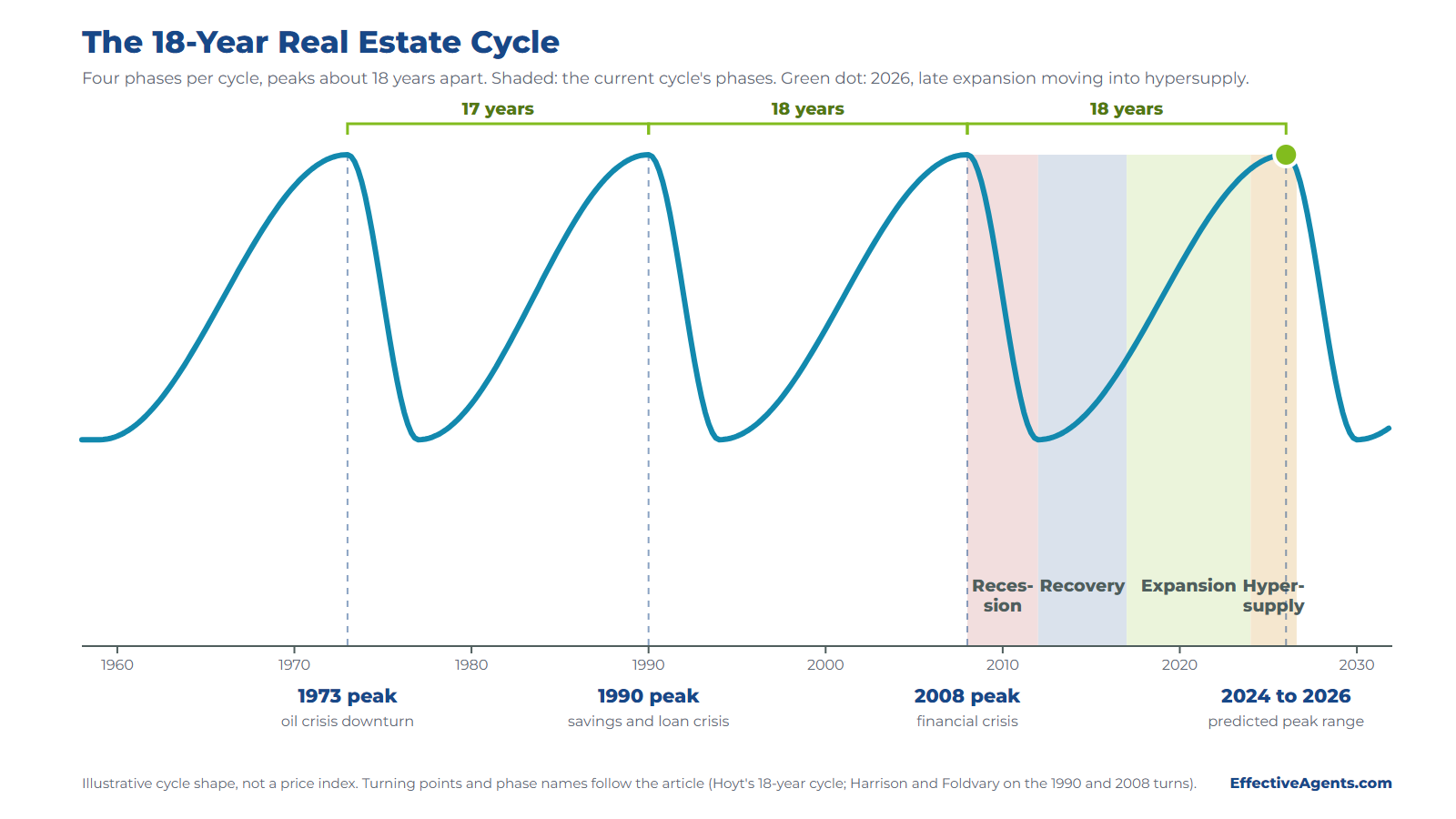
The four phases of the real estate cycle form a continuous wave pattern. Recovery leads to expansion, which eventually tips into hypersupply before declining into recession. Then the cycle begins again. Each phase presents distinct characteristics, opportunities, and risks that affect buying and selling strategies differently.
Navigate Market Cycles with Expert Guidance
Top-performing agents understand local market cycles and can help you time your transaction for optimal results.
Find a Top Agent in Your AreaThe Four Phases of the Real Estate Cycle
Dr. Glenn Mueller of the University of Denver has spent decades analyzing market cycles across 54 major metropolitan areas and five property types. His research demonstrates that while cycle timing varies by location and property type, the fundamental pattern of four phases remains consistent. Understanding each phase helps you identify where your market stands and what likely comes next.
The Real Estate Market Cycle
Phase 1: Recovery
The recovery phase marks the bottom of the market trough. Occupancy rates are at their lowest, demand remains weak, and new construction is minimal or nonexistent. Rental growth is typically flat or still declining, and if positive growth occurs, it often lags behind inflation. This phase can be difficult to identify while living through it because conditions still feel recessionary.
During recovery, excess construction from the previous cycle has stopped, and the market begins slowly absorbing existing oversupply. As Harvard Extension School economist Teo Nicolais explains, identifying the true beginning of recovery is challenging because it shares many characteristics with recession. The key difference is that demand growth has begun, even if barely perceptible.
Recovery Phase Strategy
Buyers can find excellent value during recovery as sellers remain motivated and competition is low. This phase often presents the best opportunities for long-term appreciation, though patience is required as market momentum builds slowly.
Phase 2: Expansion
Expansion is the upswing where demand grows, prices rise, and vacancy rates drop. GDP typically returns to normal levels, job growth strengthens, and unemployment decreases. As occupancy improves, landlords and sellers can command higher prices, eventually reaching levels that justify new construction.
This phase represents what many consider the ideal market condition. According to JPMorgan Chase research, the expansion phase creates equilibrium between supply and demand at its peak, though this balance is temporary. Development activity returns during expansion, but the lag time required for planning, permitting, and construction means new supply typically arrives after the market has already tightened.
The expansion phase can last for years. Historical data shows that the overall up-cycle tends to be a slow, long-term climb. During all of this time, occupancy rates and rents continue increasing, creating what economists call rent growth acceleration. When prices begin reflecting anticipated future growth rather than current conditions, the market approaches its cyclical peak.
Phase 3: Hypersupply
Hypersupply begins when the equilibrium between supply and demand tips toward excess. This imbalance can result from overbuilding during expansion or from reduced demand as economic conditions shift. The first warning sign is rising inventory and increasing vacancy rates, even while prices may still be growing.
According to Blackstone's research, the hypersupply phase is marked by supply growth exceeding demand growth. Rent growth typically remains positive but begins decelerating. Many market participants fail to recognize this peak until well after it passes because occupancy rates still appear strong and well above long-term averages.
Recognizing Hypersupply
Key indicators include: homes staying on market longer, increasing price reductions, slowing price appreciation, rising inventory levels, and new construction continuing despite softening demand. Sellers who recognize these signals early can still achieve strong prices before the market turns.
Phase 4: Recession
In the recession phase, supply significantly outweighs demand. Vacancy rates rise, prices decline, and sellers often rely on concessions and price reductions to attract buyers. New construction stops, though projects started during hypersupply continue coming to market, adding to the oversupply problem.
This phase presents opportunities for well-capitalized buyers. Distressed properties, foreclosures, and motivated sellers can offer significant discounts to replacement cost. However, buyers must be prepared to hold properties through the full recovery, as the recession phase can persist for several years before conditions improve.
| Phase | Market Characteristics | Buyer Strategy | Seller Strategy |
|---|---|---|---|
| Recovery | Low occupancy, flat/negative growth, minimal construction | Excellent entry point for long-term holds | Consider holding if not urgently needed |
| Expansion | Rising demand, price growth, increasing construction | Good time to buy before peak prices | Strong selling conditions, multiple offers likely |
| Hypersupply | Rising inventory, slowing growth, peak prices | Increased negotiating power | Optimal time to sell, prices at or near peak |
| Recession | Declining prices, high vacancy, distressed sales | Bargain opportunities for patient buyers | Consider renting or holding if possible |
The 18-Year Real Estate Cycle
Homer Hoyt's research revealed a striking pattern: real estate markets have followed an approximately 18-year cycle since at least 1800. This pattern consists of roughly 14 years of growth, often with a mid-cycle pause, followed by about four years of decline and stagnation. While not perfectly precise, this rhythm has proven remarkably consistent across different eras.
Economist Fred Foldvary famously used this cycle theory to predict the 2008 financial crisis years in advance. Writing in 1997, he stated that the next major bust, 18 years after the 1990 downturn, would occur around 2008 if there were no major interruptions such as a global war. His prediction proved stunningly accurate.
The 18-year cycle theory suggests peaks typically occur around 18 years after the previous trough. With the last major crash bottoming around 2011-2012, this framework indicates the current cycle could approach its peak in the mid-2020s. However, economists emphasize that cycles are not perfectly predictable, and various factors can extend or compress the timeline.
Historical Perspective
According to NAREIT research, the complete real estate market cycle averages about 18 years in duration, though individual phases vary considerably. The 2007-2009 downturn was particularly severe due to the financial crisis, making the subsequent recovery longer than typical.
Where Are We Now in the Cycle?
Current market data suggests the U.S. housing market has moved through expansion and entered a transitional period. According to HousingWire analysis, inventory growth has slowed from 33% year-over-year in mid-2025 to approximately 10% as of early 2026, signaling a shift from the supply-constrained conditions that defined the post-pandemic market.
Updated August 2026: existing-home sales ran at a 4.06 million annual pace in July (down 1.7% from June, up 0.7% from a year earlier) at a median price of $434,100, up 2.0% year over year, with 1.54 million homes for sale, a 4.6-month supply, according to the National Association of Realtors. That is the profile of a market moving from late expansion toward hypersupply: more inventory, slower sales, price growth fading but not yet reversing.
NAR Chief Economist Lawrence Yun noted that 2025 was another tough year for homebuyers, marked by record-high home prices and historically low home sales. However, conditions began improving in the fourth quarter, with lower mortgage rates and slower home price growth creating more balanced conditions.
Blackstone's Global Head of Real Estate Nadeem Meghji describes the current environment as the beginning of a new phase in the cycle. Commercial real estate values peaked in 2022 before declining 22% over the following two years, but by early 2024, clear signs emerged that values were stabilizing. Real estate remains attractively priced on a relative basis, with values only 7% above their trough.
Regional Variations
Market cycles do not affect all areas equally. The National Association of Realtors reports that home prices increased in 77% of metro markets during the third quarter of 2025, but price declines are occurring mainly in southern states where robust new home construction has increased supply. Markets in the supply-constrained Northeast and more affordable Midwest have generally seen stronger price appreciation.
Markets Showing Strength
- Northeast markets with limited supply
- Midwest metros like Columbus, Indianapolis, Kansas City
- Areas near major universities
- Markets with job growth in technology and healthcare
Markets Facing Pressure
- Sun Belt metros with high new construction
- Texas and Florida markets with inventory builds
- Pricey coastal metros seeing buyer pullback
- Areas dependent on single industries
Key Indicators to Watch
Identifying your local market's cycle position requires monitoring several key indicators. No single metric tells the complete story, but together they provide a clear picture of market direction and momentum.
Supply Indicators
Inventory levels serve as the foundation for cycle analysis. Rising inventory typically signals a shift from expansion toward hypersupply, while declining inventory suggests recovery or expansion. According to current data from the Federal Reserve Bank of St. Louis, national housing inventory is up approximately 10% year-over-year, with 34.7% of homes having taken a price cut.
New construction activity provides forward-looking insight. Blackstone research shows construction starts have declined more than 60% across major U.S. sectors, which typically leads to stronger rent growth and higher values as reduced supply meets ongoing demand.
Demand Indicators
Sales volume and days on market reveal buyer activity levels. The median time on market sits at approximately 73 days nationally, reflecting a more measured sales pace than the rapid turnover of earlier expansion years. First-time homebuyers accounted for 30% of sales in late 2025, unchanged from the prior year.
Mortgage rates significantly influence demand. According to Redfin, mortgage rates averaged 6.6% in 2025, down slightly from 6.7% the previous year. NAR economists estimate that a one percentage-point drop in mortgage rates can expand the pool of qualifying households by approximately 5.5 million, including about 1.6 million renters who could become first-time buyers.
Price Indicators
Price trends confirm cycle positioning. The national median single-family existing-home price grew 1.7% year-over-year to $426,800 in the third quarter of 2025, showing continued appreciation but at a moderating pace. Price growth deceleration often signals the transition from expansion to hypersupply.
What These Numbers Mean for You
A market with rising inventory, slowing price growth, and increasing days on market is likely transitioning from expansion to hypersupply. Sellers should consider listing sooner rather than later, while buyers gain negotiating leverage. A top-performing agent can help you interpret local data and develop the right strategy.
Get a Data-Driven Market Analysis
Top agents track these indicators in your specific market. Get matched with a high-performing Realtor who can help you navigate current conditions.
Connect with a Top Local AgentStrategies for Each Cycle Phase
Your approach to buying or selling should align with current market conditions. What works during expansion may backfire during recession, and vice versa. Understanding phase-appropriate strategies helps you optimize outcomes regardless of where the market stands.
Buying Strategies by Phase
Recovery: This phase offers the best long-term value for patient buyers. Prices are at or near their lows, and sellers remain motivated. However, financing may be tighter, and the market may feel uncertain. Buyers who can act during recovery often see significant appreciation as the cycle turns upward.
Expansion: Competition increases during expansion, but opportunities still exist. Focus on emerging neighborhoods before prices fully adjust, and be prepared to move quickly on desirable properties. Working with an experienced agent becomes critical as multiple-offer situations become common.
Hypersupply: Negotiating power shifts to buyers as inventory rises. Take time to evaluate options, request seller concessions, and avoid overpaying based on peak comparable sales. Properties that have sat on the market present particular opportunities.
Recession: Distressed sales, foreclosures, and highly motivated sellers create bargain opportunities. However, buyers must have strong financing and patience, as market conditions may worsen before improving. Only purchase what you can afford to hold long-term.
Selling Strategies by Phase
Recovery: Unless you must sell, consider holding until conditions improve. If selling is necessary, price competitively and expect longer market times. Highlight value and be prepared to negotiate.
Expansion: This is typically the optimal time to sell. Buyer demand supports strong prices, and well-prepared properties often receive multiple offers. Invest in presentation and marketing to maximize your sale price.
Hypersupply: Act quickly if you plan to sell. Price strategically based on current competition, not past peak sales. The sellers who list early in this phase typically achieve better results than those who wait.
Recession: Avoid selling unless absolutely necessary. If you must sell, consider renting temporarily or accepting that pricing will reflect distressed market conditions. Work with an experienced agent who can identify remaining buyer demand.
Why Agent Expertise Matters During Cycle Transitions
Market transitions create both opportunity and risk. The difference between excellent and poor outcomes often comes down to working with an agent who understands cycle dynamics and can translate that knowledge into effective strategy.
Top-performing agents track local market indicators continuously, identifying shifts before they become obvious to casual observers. They understand how macro trends affect specific neighborhoods and property types, and they adjust their advice accordingly. During expansion, this expertise helps sellers maximize prices and buyers compete effectively. During transitions, it helps clients avoid costly timing mistakes.
What Top Agents Provide
- Real-time local market analysis
- Cycle-appropriate pricing strategies
- Neighborhood-specific trend identification
- Negotiation leverage based on market position
- Timing recommendations for optimal outcomes
The Cost of Poor Timing
- Selling too late in hypersupply means lower prices
- Buying at peak expansion means potential value decline
- Missing recovery opportunities limits long-term gains
- Misjudging market direction leads to extended market times
- Wrong strategy costs thousands in transaction outcomes
According to NAR research, agent-assisted home sales consistently achieve higher prices than FSBO transactions, with the median differential exceeding $65,000. This advantage becomes even more pronounced during market transitions when expertise in pricing, negotiation, and timing directly impacts outcomes.
What Comes Next
Economists project continued normalization in the housing market through 2026. HousingWire forecasts the 10-year Treasury yield to range between 3.80% and 4.60%, with mortgage rates between 5.75% and 6.75%. Lower rates would stimulate demand and potentially support prices, while higher rates would continue the current cooling trend.
Several factors will influence how the current cycle unfolds:
Construction Activity: New supply has declined dramatically, with starts down more than 60% from recent peaks in most sectors. This reduced construction typically leads to tighter supply conditions within 18-24 months, potentially supporting prices even as other factors cool demand.
Interest Rates: The Federal Reserve's policy trajectory remains the single largest variable. Each percentage point decline in mortgage rates expands the qualified buyer pool by millions of households, while rate increases constrain affordability further.
Economic Conditions: Job growth, wage increases, and consumer confidence directly influence housing demand. Current conditions show resilient employment but affordability challenges that have pushed home sales to multi-decade lows on a population-adjusted basis.
Policy Changes: Government housing policy, including zoning reform, federal land availability, and tax treatment, could influence supply and demand dynamics in ways that extend or compress the typical cycle timeline.
The Bottom Line
Markets do not crash overnight, nor do they recover instantly. The 18-year cycle suggests significant time remains before a major correction, but local market conditions vary dramatically. Your specific situation, including timeline, financial position, and local market dynamics, should drive decisions more than macro predictions.
Ready to Make Your Move?
Whether buying or selling, working with a top-performing agent who understands market cycles gives you a strategic advantage. EffectiveAgents matches you with vetted Realtors based on actual performance data.
Find Your Top Agent NowFrequently Asked Questions
How long does a typical real estate cycle last?
Research by economist Homer Hoyt identified an approximately 18-year real estate cycle dating back to at least 1800. This typically includes about 14 years of growth (with potential mid-cycle pauses) followed by roughly four years of decline and stagnation. However, individual cycles can range from 17 to 21 years depending on economic conditions, policy changes, and external events like wars or financial crises.
How can I tell what phase my local market is in?
Monitor key indicators including: inventory levels (rising inventory suggests hypersupply approaching), days on market (increasing time indicates cooling demand), price trends (slowing appreciation signals transition), new construction activity, and sales volume. Your local real estate agent should be tracking these metrics and can provide specific analysis for your area. Dr. Glenn Mueller's Market Cycle Monitor, available through the University of Denver, tracks cycle positions across 54 major metro areas.
Should I wait for a recession to buy a house?
While recession phases offer lower prices, timing the market bottom is extremely difficult. Most economists recommend buying when you find the right property and can afford the payments, rather than trying to predict cycle troughs. Additionally, during recession phases, lending becomes tighter, inventory may be limited to distressed properties, and you may face holding costs while waiting for recovery. A home purchase should align with your personal timeline and financial situation first.
Is the housing market going to crash soon?
Current market conditions differ significantly from pre-2008 crash conditions. Lending standards are much stricter, homeowner equity is at record highs, and distressed sales remain at historic lows (approximately 2% of transactions). While price growth is moderating and some markets face inventory buildups, most economists project continued normalization rather than a crash. The 18-year cycle theory suggests the current cycle has room to run before a major correction, though local market conditions vary considerably.
How do interest rates affect real estate cycles?
Interest rates significantly influence both the timing and severity of cycle phases. Lower rates expand the pool of qualified buyers (each percentage point decline adds approximately 5.5 million qualifying households nationally) and can extend expansion phases. Higher rates constrain affordability, reduce demand, and can accelerate the transition to hypersupply and recession. The Federal Reserve's policy decisions represent one of the most significant variables affecting cycle duration and intensity.
Do all property types follow the same cycle?
No. Different property types (residential, commercial, industrial, retail) move through cycles at different speeds and may be in different phases simultaneously. Even within residential real estate, single-family homes, condos, and multifamily properties can experience divergent trends. Geographic variations add another layer, with gateway markets often leading turns from recession to recovery, and secondary markets following later. This is why local expertise is essential for accurate market assessment.
What role do real estate agents play during market transitions?
Market transitions are precisely when agent expertise matters most. Top-performing agents track local indicators continuously, identify shifts before they become obvious, and adjust strategies accordingly. During transitions, proper pricing becomes critical since overpriced listings in a cooling market often chase prices downward. Agents with strong negotiation skills help sellers maximize value and help buyers avoid overpaying. The typical $65,000 advantage of agent-assisted sales over FSBO becomes even more significant during volatile market conditions.
Disclaimer: This article is for informational purposes only and should not be considered financial, investment, or legal advice. Real estate markets are influenced by numerous factors including interest rates, economic conditions, government policy, and local market dynamics. Past performance does not predict future results. Always consult with qualified professionals before making real estate decisions. Statistics and market data are current as of the publication date and subject to change.